
WINTER HVAC GUIDE - PART II
Turning Your Answers Into a Winter Preparedness Process Document Using Al
How to Convert Your Strategic Thinking Into Executable Documentation Without Spending Weeks Writing It Yourself
THE PROBLEM:
Expertise That Lives in Experience, Not in Documents
You just worked through six questions about winter readiness. Maybe you gathered your team and discussed each scenario. Maybe you even typed out detailed answers. You know how your winter HVAC operation should work. You understand which equipment is vulnerable, how to prioritize response, what parts to stock.
But here's what happens in most organizations: someone volunteers to "document the winter process." Three weeks later, they've written up the equipment assessment approach and maybe the priority response matrix. The parts inventory section is half-finished. The documentation requirements are "still being refined." By the time cold weather actually arrives, you're operating the same way you always have because the documentation never materialized.
Or worse someone does complete it. They spend forty hours writing a comprehensive winter preparedness manual. It's thorough. It's detailed. And it's immediately outdated because they documented last year's approach, but this year you have different contractors, you adjusted your priority criteria after the first cold snap, and nobody has time to update the manual.
The person who knows how your winter operation should run can't clone themselves. And they definitely can't spend two weeks every fall writing documentation that's obsolete before temperatures drop.
THE FRAMEWORK:
Why Al Transforms Process Documentation
Here's the reality: you already have the knowledge. You answered the six questions. You probably had conversations where your team talked through every scenario, every decision point, every contractor contact. Or you typed out detailed responses. That information exists.
The problem was never having the knowledge, it was structuring that knowledge into a usable process document that someone could actually follow. That's the part that took weeks and never quite got finished.
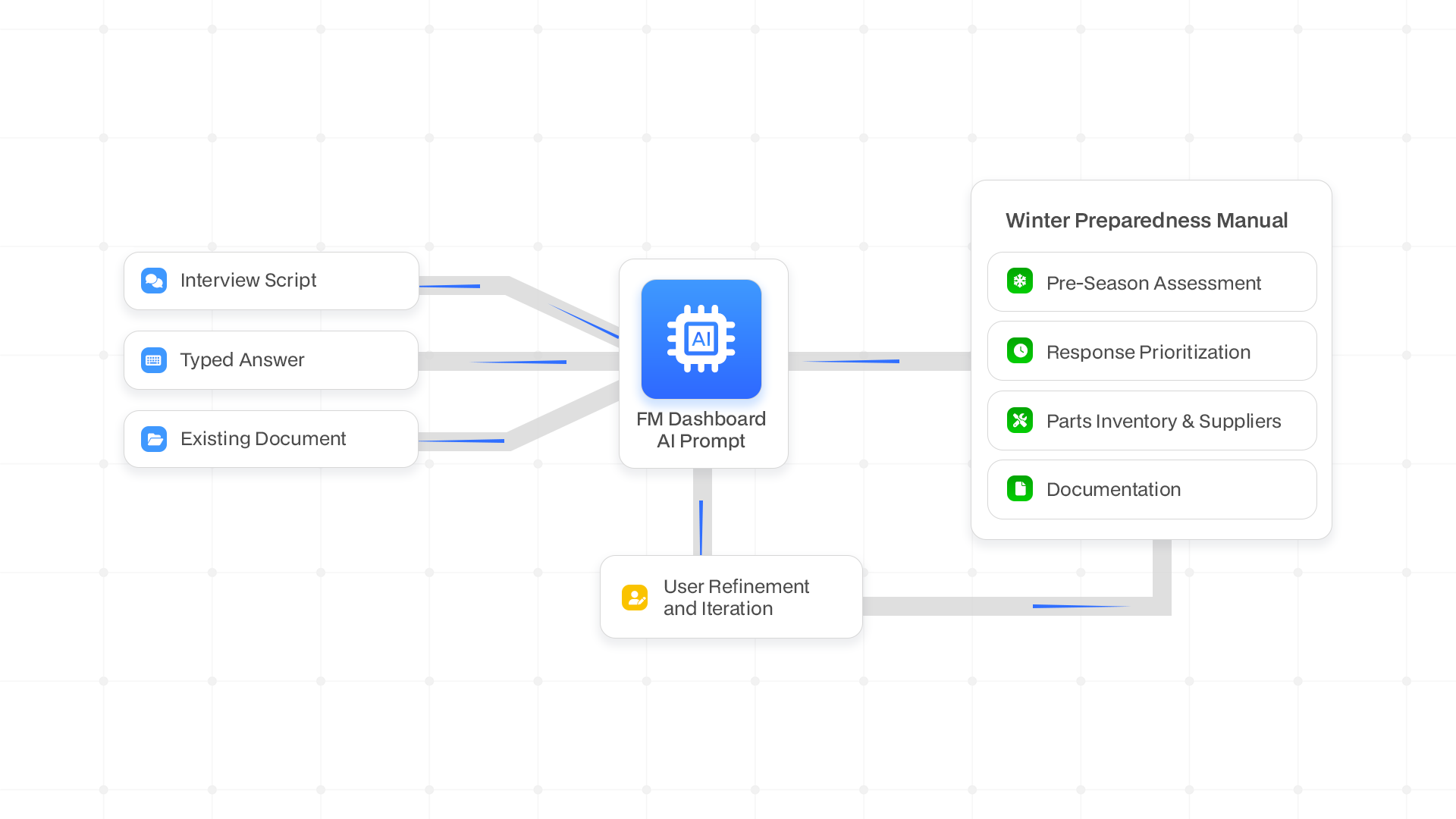
AI solves that specific problem. You can take your interview transcript, your typed answers, or your notes from team discussions, feed it into an AI tool, and get a structured process document back in minutes. Not perfect but 90% complete, properly formatted, with logical flow and clear decision points.
The goal isn't to have AI write your process for you. The goal is to have AI structure the knowledge you already articulated into a document that's immediately useful. You'll still need to refine it, add company-specific details, and adjust for your exact operation. But you're starting from 90% completion instead of staring at a blank page.
What Makes a Good Winter Preparedness Process Document
Before we get into the actual prompt, you need to know what you're aiming for. A good winter preparedness document includes:
1. Clear vulnerability assessment methodology
Not "check old equipment" but "pull CMMS reports for all units over 10 years old OR units with 3+ service calls in the previous 12 months OR units that missed scheduled PM in the last 18 months. Cross-reference with high-priority location list. Create a ranked priority target list by priority location + equipment vulnerability."
2. Specific response prioritization criteria.
Which locations get 2-hour response, which get 4-hour response, which get 8-hour response. What factors determine priority (revenue, traffic patterns during weather, equipment age, customer impact). Who has authority to override priorities when circumstances demand it.
3. Strategic parts inventory specifications.
Which components to stock, how many of each, where to stage them. Supplier mapping for rapid sourcing of non-stocked items. Process for inventory management and replenishment.
4. Documentation requirements at each step.
What gets logged in your CMMS for pre-season assessments, emergency service calls, weather-related delays, parts usage. How you track seasonal spending against budget.
5. Escalation paths when standard processes can't handle conditions.
Your primary contractor is overwhelmed. Equipment needs replacement but you don't have capital approval. Weather makes site access dangerous. Who makes what decisions, how fast, and what communication follows.
If your process document has those five elements, someone can pick it up and manage winter HVAC operations without constantly asking you what to do next.
THE PROMPT:
What to Feed the AI
Here's the prompt structure that takes your interview transcript or typed answers and generates a usable winter preparedness document. You can copy this, adjust the bracketed sections for your specifics, and use it with any AI tool.
The Prompt:
I need you to create a comprehensive winter HVAC preparedness process document for a facilities maintenance department managing [NUMBER] convenience store/gas station locations across [REGIONS/STATES].
I'm going to provide you with either:
-
A transcript of a conversation where our team discussed how we
prepared for and manage winter HVAC operations, OR
-
Written answers to key questions about our winter preparedness approach
Your job is to take that raw information and structure it into a clear, actionable process document that someone new to our operation could use to prepare for and manage winter HVAC operations independently.
Required sections for the document:
1. Pre-Season Equipment Assessment and Preparation
-
How we identify vulnerable equipment before winter arrives
-
Criteria for prioritizing which units need pre-season service
-
Pre-season PM requirements and completion timeline
-
Contractor coordination for preparation work
-
Budget allocation for preventive vs. reactive spending
2. Response Prioritization and Resource Allocation
-
Specific criteria for Tier 1, Tier 2, and Tier 3 priority sites
-
How we make priority decisions when multiple sites report failures simultaneously
-
Who has authority to make priority calls and when
-
Communication protocols with store operations during emergencies
-
Escalation process when contractor capacity can't meet demand
3. Strategic Parts Inventory and Supplier Management
-
Which components we stock based on historical failure patterns
-
Where parts are staged (on-site vs. regional hubs)
-
Inventory quantities and restocking procedures
-
Supplier mapping for rapid sourcing of non-stocked items
-
Process for contractor access to parts inventory
4. Emergency Response and Service Execution
-
Standard response procedures when sites report heating failures
-
Step-by-step dispatch and contractor coordination
-
Decision-making authority for emergency approvals
-
Quality verification and completion documentation requirements
-
How we handle overnight and weekend emergencies
5. Weather-Related Documentation and Context Capture
-
What weather factors we document in work orders
-
How we capture service delays related to conditions
-
Why this documentation matters for performance evaluation
-
How we use weather data for seasonal planning
6. Performance Tracking and Seasonal Review
-
What metrics we track throughout winter
-
How we evaluate contractor performance
-
Seasonal cost analysis and budget variance review
-
Process for incorporating lessons into next year's preparation
Formatting requirements:
-
Use clear headers and subheaders for easy navigation
-
Include specific decision points with "IF/THEN" logic where appropriate
-
Call out any gaps where we need to add more specific information
-
Use bullet points for lists and steps, but full paragraphs to explain reasoning or context
-
Flag any areas where our current process seems unclear or incomplete
What to avoid:
-
Don't make up details we didn't provide
-
Don't use generic facilities management jargon—use our specific terminology
-
Don't create overly complicated flowcharts or diagrams (stick to clear written process)
-
Don't assume standard industry practices unless we specifically mentioned them
Input to process: [PASTE YOUR INTERVIEW TRANSCRIPT OR TYPED ANSWERS HERE]
Create a process document that's immediately usable but also identifies where we need to add more detail or make decisions we haven't clarified yet.
What to Include With the Prompt
Along with the prompt itself, you need to provide the raw material. This is either:
Option 1: Your Interview Transcript
If you recorded a conversation where you and your team talked through the five questions, get that audio transcribed. Most AI tools can transcribe directly, or you can use a service like Otter.ai or Rev. The transcript doesn't need to be perfectly clean. AI can work with conversational language, tangents, and even incomplete thoughts. Just make sure the core information from your five-question discussion is captured.
Option 2: Your Typed Answers
If you wrote out answers to the five questions, that works just as well. Don't worry about perfect formatting or complete sentences. The AI will structure it. Just make sure you've addressed:
-
How you identify vulnerable equipment
-
What your priority response criteria are
-
Which parts you stock and where
-
What gets documented and why
-
How you measure performance
-
Who owns what decisions
Optional Additions:
If you have any existing documentation even outdated or incomplete include it. Contractor lists, old service agreements with response time requirements, equipment inventories, previous work order templates. The AI can incorporate that information into the new process document, saving you from retyping details that haven't changed.
EXAMPLE:
What Good Output Looks Like
Let's look at what happens when you feed the prompt properly. Here's a before and after.
Before: Raw Interview Transcript Snippet
"So we need to figure out which units are gonna give us problems before it gets cold. Usually the old ones, like anything over ten years. And the ones that we had to call on a bunch last year. Also if we skipped PMs that's probably bad. We should make a list or something. Then we can get Jim to go check them out in October or November before it's freezing. That way we're not just reacting when stuff breaks."
After: Structured Process Document Output
Pre-Season Equipment Assessment and Preparation
The maintenance coordinator completes a comprehensive vulnerability assessment no later than October 15th each year. This assessment identifies HVAC equipment most likely to fail during winter operations and becomes the foundation for pre-season preparation activities.
Vulnerability identification criteria:
Equipment receives priority assessment if it meets any of the following conditions:
-
Age: Rooftop units 10+ years old (calculate from installation date in CMMS)
-
Service history: Units requiring 3+ service calls in the previous 12-month period
-
Maintenance compliance: Units that missed scheduled preventive maintenance in the last 18 months
-
Previous winter failures: Any unit that experienced failure during previous winter season
Assessment methodology:
The coordinator generates three reports from the CMMS:
-
Equipment age report: All HVAC units with installation dates older than [CURRENT YEAR - 10]
-
Service frequency report: All HVAC units with 3+ work orders in the trailing 12 months
-
PM compliance report: All HVAC units with missed or overdue preventive maintenance
These reports are cross-referenced with the location priority matrix (see Section 2) to create a ranked preparation target list. Priority 1 locations with vulnerable equipment receive assessment first.
Pre-season service completion:
The coordinator schedules contractor assessments for all identified equipment by November 1st. Assessment scope includes:
-
Complete visual inspection of all heating components
-
Ignition system testing and cleaning
-
Blower motor and belt inspection
-
Thermostat calibration verification
-
Heat exchanger condition assessment (units 8+ years old)
-
Documentation of any components showing wear or degradation
Gap identified: Interview mentioned "get Jim to go check them out" but didn't specify which contractor (Jim's company name not provided), what the assessment should include beyond basic inspection, or how findings get documented and prioritized for repair vs. monitor vs. replace decisions.
Action needed: Define complete assessment scope, documentation requirements, and decision criteria for action items coming out of assessments.
See what happened?
The AI took conversational, incomplete information and:
-
Created logical structure - Organized scattered thoughts into clear sections with headers
-
Identified timing requirements - Turned "October or November into specific deadlines (October 15th, November 1st)
-
Assigned operational details - Specified how to identify vulnerable equipment (CMMS reports) and how to prioritize (cross-reference with location priorities)
-
Flagged gaps - Called out where information was incomplete or unclear
-
Preserved core intent- Kept the proactive assessment approach while making it specific enough to execute
What the AI Did Well:
The output turned "figure out which units are gonna give us problems" into a specific vulnerability assessment with clear criteria. It took rough timing ("October or November") and created a staged timeline with specific completion dates. It caught that a contractor was mentioned by first name but full contact information and scope details weren't provided, flagging it as a gap.
Common Issues to Watch For and Fix:
Even with a good prompt, AI output needs human refinement. Here's what to watch for:
AI being too generic.
If the output says "coordinate with appropriate contractors" instead of "contact Acme HVAC Services (primary contractor for Midwest region, contact: Mike Johnson, 555-0199) and schedule assessments by October 15th," make it specific. Generic process documents don't help anyone execute.
Missing your company-specific terminology or tools.
If you use ServiceChannel or Corrigo or a custom CMMS, make sure that's reflected. If you call high-priority sites "flagship locations" or "core stores," use your terminology. Add a note to the prompt: "We use [CMMS NAME] for work orders and refer to our high-priority locations as [YOUR TERM]."
Over-complicating simple steps.
Sometimes AI will turn "check if units are old" into an eight-step age verification protocol with documentation templates and approval workflows. If something is straightforward, simplify it. Your process document should be clear, not bureaucratic.
Assuming standard practices you don't actually follow.
If the AI adds steps you didn't mention like "conduct quarterly equipment audits throughout winter" and you don't actually do that, remove it. Document the process you'll actually execute, not the process that sounds comprehensive.
HOW TO ITERATE:
Feeding the Output Back With Refinements
Your first AI-generated draft won't be perfect. That's expected. Here's how to refine it:
-
Read through the entire document and highlight gaps. Where did the AI say "NEED TO CLARIFY" or "Action needed"? Those are places where your original answers were incomplete.
-
Fill in the gaps with specific information. Write out the missing details complete contractor names and contacts, specific assessment requirements, equipment lists, decision criteria you didn't articulate clearly.
-
Feed it back to the AI with refinement instructions. Copy the draft document, add your new information, and give the AI a refined prompt:
"I've reviewed the winter preparedness document you created. I'm providing additional information to fill gaps and correct areas that need more specificity. Please update the document by incorporating this new information while maintaining the same structure and format:
[PASTE YOUR ADDITIONS AND CORRECTIONS]
Update the document and remove any 'gap identified' or 'action needed' notes where I've now provided the missing information."
You can iterate this way 2-3 times until you have a complete, accurate process document. Each iteration takes minutes, not days.
What You Have Now
At this point, you have a complete winter preparedness process document. Someone could read it and understand:
-
How to identify vulnerable equipment before winter
-
What criteria determine response priorities
-
What parts to stock and where
-
How to coordinate emergency responses
-
What needs documentation and why
That document is immediately more useful than the scattered knowledge that existed last week. But a process document by itself doesn't execute. You still need to answer: who's doing what, specifically?
STRATEGY CALL
Schedule a 15-Minute Snow Operations Strategy Call today!
Let's build an operational plan that runs without you, protecting your sites and your budget this winter.