
SNOW OPERATIONS GUIDE - SECTION IV
KPIs That Keep Your Winter HVAC Operation Accountable
How to Measure What Actually Matters So You Know If Your Process Is Working or Where It's Breaking Down
THE PROBLEM:
"No Major Complaints?" Is Not a Performance Metric
You've built the process. You've assigned ownership. You've created SOPs. The first cold snap hits, and it feels manageable. Some units need service, but contractors respond. Sites get repaired. No angry escalations from store operations. Success, right?
Three months later when winter ends and you're reviewing contractor performance for next season's contracts, you realize you have no objective performance data. You think your primary contractor was "generally responsive," but you can't quantify their average response time or compare it to industry standards. You believe pre-season assessments helped prevent failures, but you can't prove it because you don't know your failure rate this year versus last year. One location seemed to have constant HVAC problems, but you can't tell if that's equipment age, maintenance execution, or just bad luck.
So you renew contracts based on gut feel, keep the same preparation approach, and hope next winter goes even better. That's not management. That's hoping with documentation.
Here's what happens when you manage Winter HVAC without metrics:
You can't hold contractors accountable objectively. "You guys seemed slow this year" doesn't hold up when a contractor replies "our average response time beat our SLA by 15 minutes." Were they slow? You don't know. You didn't track it.
You can't make informed contract decisions. Should you negotiate lower rates based on excellent performance? Or should you replace contractors because they underdelivered? Without data, you're negotiating blind or making changes based on whoever complained loudest.
You can't identify if your coordinator is struggling or if your equipment needs replacement investment. Work orders close slowly is that because your coordinator is overwhelmed, because contractors aren't submitting documentation promptly, or because equipment complexity is increasing? Without metrics, you can't tell the difference.
You can't justify budget requests. When leadership asks why you need 20% more for winter preparedness next year, "equipment is getting older" might work once. "Our preventive maintenance investment reduced emergency service costs by 35% while equipment age increased 8%, proving ROI on preparation spending" works every time.
Real example:
A facilities team managing 200 locations thought they had solid contractor relationships and reasonable equipment performance. When they finally started tracking metrics mid-season, they discovered their primary contractor was averaging 4.5 hours from dispatch to on-site arrival significantly exceeding their 2-hour SLA. They'd been paying for contracted response times they weren't receiving. More importantly, they discovered that 40% of their emergency service calls were to the same 15 locations equipment that should have been replaced years ago was generating disproportionate maintenance costs. Switching to a more responsive contractor and replacing the worst-performing equipment reduced their next winter's costs by 30%.
THE FRAMEWORK
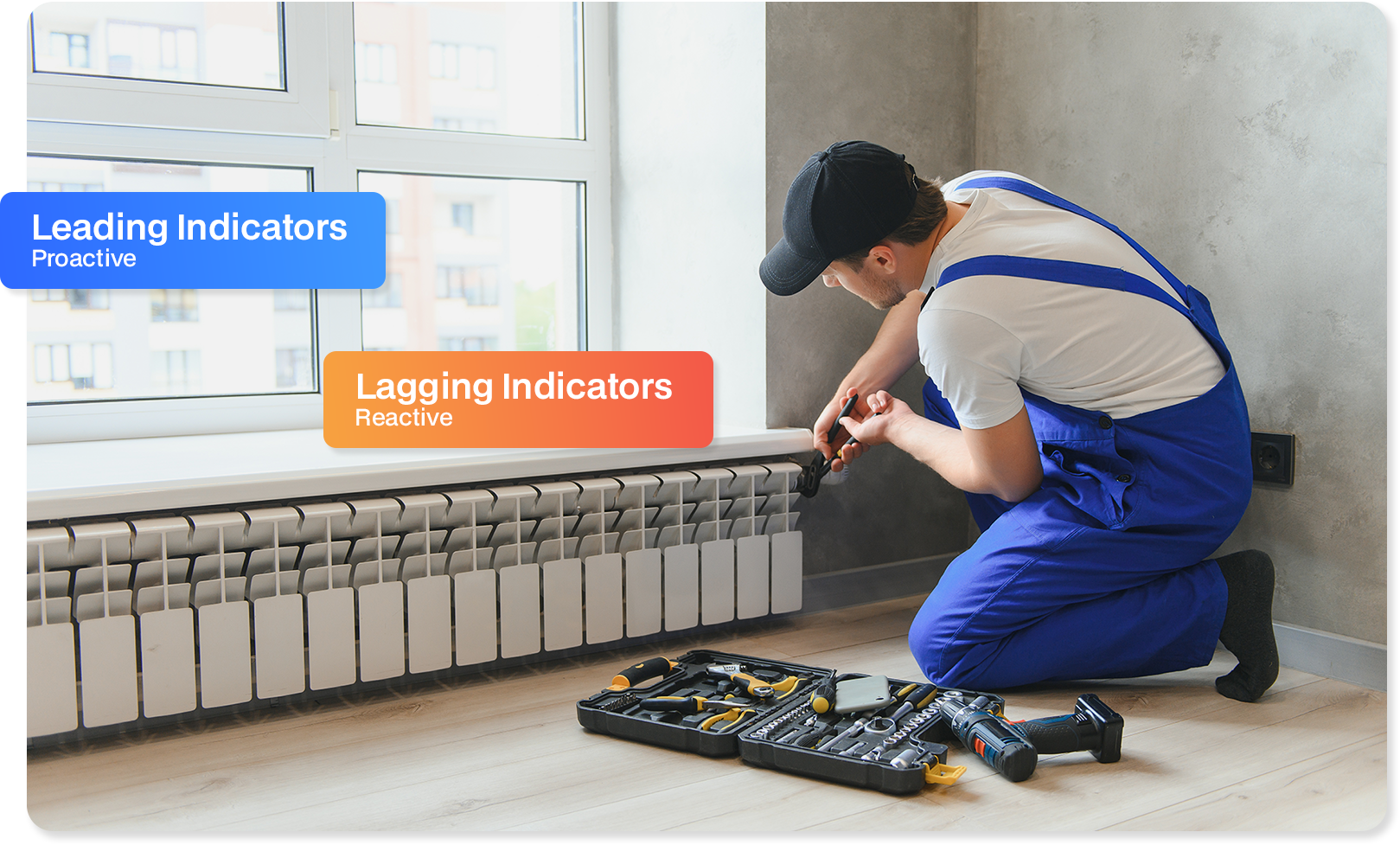
Leading vs. Lagging Indicators
Before we get into specific metrics, you need to understand the difference between indicators that tell you what already happened versus indicators that tell you what's about to happen.
Lagging indicators measure outcomes after they occur:
-
Customer complaints about cold store
-
Total seasonal spend maintenance spending
-
Number of equipment failures requiring emergency service
-
Contractor invoice disputes
These matter. You need to track them. But they tell you about problems after damage is done. A customer already experienced poor conditions. Money was already spent. Equipment already failed.
Leading indicators measure performance while you still have time to fix problems:
-
Pre-season assessment completion rate by target date
-
Contractor response time from dispatch to on-site arrival
-
Percentage of failures occurring in equipment that received pre-season assessment
-
Parts availability rate when contractors need components
These metrics tell you that something's going wrong before it becomes a crisis. Assessment completion falling behind schedule in October means you'll enter winter unprepared fix it now before cold weather hits. Contractor response times creeping from 2 hours to 3.5 hours indicates a capacity problem you can address before it causes extended outages. Discovering that parts aren't available when contractors need them lets you adjust inventory before multiple repairs get delayed.
Winter HVAC is unique because the season is short and the margin for error is small. You get maybe one cold snap to realize your process isn't working before you're managing constant emergencies. Your metrics need to tell you fast when something needs adjustment.
Your KPI framework should answer three questions:
1. Are we preventing failures through preparation? (Proactive vs. reactive performance)
2. Are we responding effectively when failures occur? (Service quality and speed)
3. Are we managing costs strategically? (Budget performance and efficiency)
If you can answer those three questions with data instead of opinions, you're ahead of 90% of facilities operations.
Essential KPIs Every Winter HVAC Operation Should Track
These are the non-negotiable metrics. Regardless of your size, region, or contractor structure, you should track these. I'll tell you what to measure, why it matters, how to measure it, and what good performance looks like.
Preparation and Prevention Metrics
1. Pre-Season Assessment Completion Rate
What it measures:
Percentage of identified vulnerable equipment that receives pre-season assessment by target date (November 1st).
Why it matters:
This is your earliest indicator of whether winter preparation is on track. If assessments aren't completed on schedule, you're entering winter unprepared. This metric catches process failures in October when you can still fix them, not in January when you're managing consequences.
How to measure:
-
Total vulnerable equipment identified (from CMMS reports)
-
Equipment receiving completed pre-season assessment by November 1st
-
Calculate completion rate: (Assessed equipment ÷ Identified equipment) × 100
-
Track weekly throughout October to monitor progress
Target benchmark:
-
100% completion by November 1st
-
50% completion by October 15th (midpoint check)
-
Zero tolerance for entering winter season without completed assessments for high-priority locations
What the data tells you:
-
Completion rate under 80% by October 20th? Contractor capacity issue or scheduling delays escalate immediately and add contractor resources.
-
High-priority locations missing assessments? Coordination failure those locations should be first on the schedule.
-
Assessments completed but findings not documented in CMMS? Documentation compliance issue retrain coordinator on completion requirements.
2. Pre-Season Repair Completion Rate
What it measures:
Percentage of issues identified during pre-season assessments that receive resolution (repair or documented replacement plan) before first cold snap.
Why it matters:
Completing assessments doesn't prevent failures. Acting on assessment findings prevents failures. This metric shows whether you're actually addressing vulnerabilities or just documenting them.
How to measure:
-
Total issues identified during pre-season assessments requiring action
-
Issues resolved through repair before temperatures drop consistently below 40°F
-
Issues flagged for replacement with documented capital plan and timing
-
Calculate resolution rate: (Resolved or planned issues ÷ Total issues) × 100
Target benchmark:
-
85%+ resolution rate before cold weather arrives
-
100% of critical safety issues resolved (heat exchanger concerns, ignition failures, major component wear)
-
All unresolved issues have documented decision and plan (deferred to next season, replacement scheduled, monitor for now)
What the data tells you:
-
Resolution rate under 70%? Budget constraints or contractor capacity limiting repairs need director intervention on funding or timeline.
-
Critical safety issues unresolved? Immediate escalation required cannot operate equipment with documented safety concerns.
-
Issues documented but no decisions made? Process breakdown in repair vs. replace approval review SOP for decision authority.
3. Failure Rate in Assessed vs. Non-Assessed Equipment
What it measures:
Comparison of emergency service call rates between equipment that received pre-season assessment and equipment that did not.
Why it matters:
This proves (or disproves) the ROI of pre-season preparation. If assessed equipment fails at similar rates to non-assessed equipment, your assessment process isn't effective. If assessed equipment fails at significantly lower rates, you can justify preparation investment.
How to measure:
-
Track emergency service calls throughout winter
-
Flag whether each failed unit received pre-season assessment
-
Calculate failure rate for each group: (Failed units ÷ Total units in group) × 100
-
Compare rates
Target benchmark:
-
Assessed equipment should fail at 50% or lower the rate of non-assessed equipment
-
If assessed equipment failure rate is 10%, non-assessed should be 20% or higher
-
Narrowing gap over multiple years indicates either assessment effectiveness is declining or you've addressed the most vulnerable equipment
What the data tells you:
-
Similar failure rates between groups? Assessment process isn't identifying real vulnerabilities or repairs aren't addressing root causes.
-
Assessed equipment failing for reasons not caught in assessment? Assessment scope is incomplete expand inspection requirements.
-
Non-assessed equipment performing well? Either you got lucky or your vulnerability identification criteria are too conservative you might be over-assessing.
Response and Execution Metrics
4. Cost Per Location Per Event
What it measures:
Time elapsed from when coordinator dispatches contractor to when contractor confirms on-site arrival and begins diagnostic work.
Why it matters:
Separates your coordination speed from contractor reliability. If you dispatch within 15 minutes but contractors take 4 hours to arrive, you know where the problem is. This is also where priority response breaks down slow contractor arrival means high-priority sites wait just as long as low-priority sites.
How to measure:
-
Log timestamp when coordinator dispatches contractor in CMMS
-
Log timestamp when contractor confirms on-site arrival
-
Calculate elapsed time
-
Track by contractor, by priority tier, by time of day, by weather conditions
Target benchmark:
-
Tier 1 locations: Under 2 hours average, 90% within 2.5 hours
-
Tier 2 locations: Under 4 hours average, 90% within 5 hours
-
Tier 3 locations: Under 8 hours average, 90% within 10 hours
-
Weather adjustments: Add 1 hour to all targets during active snow/ice conditions
What the data tells you:
-
One contractor consistently over target? Reliability or capacity problem address or replace.
-
All contractors slow during specific weather events? Regional capacity problem need backup contractors for extreme weather.
-
Response times worse for certain locations? Site access issues or geographic coverage gaps adjust contractor territories or add local providers.
5. First-Time Fix Rate
What it measures:
Percentage of service calls resolved during initial contractor visit without need for parts runs, return visits, or additional diagnostics.
Why it matters:
First-time fixes minimize downtime and cost. Every return visit means another contractor trip charge, more lost sales from uncomfortable conditions, and customer frustration. Low first-time fix rates indicate either diagnostic issues (contractor can't identify problem), parts availability problems (don't have components needed), or equipment complexity (aging systems requiring specialized knowledge).
How to measure:
-
Track total emergency service calls
-
Identify calls requiring multiple visits to achieve resolution
-
Calculate first-time fix rate: (Calls resolved in single visit ÷ Total service calls) × 100
-
Track by contractor and by equipment age
Target benchmark:
-
75%+ first-time fix rate overall
-
85%+ for equipment under 5 years old (newer systems should be straightforward)
-
65%+ for equipment over 10 years old (older systems more complex)
What the data tells you:
-
Low first-time fix rate with specific contractor? Diagnostic capability issues need better-trained technicians or more experienced contractor.
-
Low rate due to parts availability? Your strategic inventory isn't comprehensive enough analyze which components caused return visits and add to stock.
-
Low rate on specific equipment models? That equipment is unreliable or overly complex consider replacement program.
6. Service Quality Verification Rate
What it measures:
Percentage of completed service work orders with required documentation (photos showing work performed, before/after conditions, components replaced) that meet quality standards.
Why it matters:
This is the difference between "contractor says it's fixed" and "we verified it's actually fixed correctly." Without documentation, you have no evidence for quality issues, no proof for warranty claims, and no way to hold contractors accountable for incomplete work.
How to measure:
-
Track total work orders marked complete by contractors
-
Track work orders with required photo documentation submitted within 4 hours of completion
-
Track work orders where photos meet quality standards (show specific work performed, components replaced, proper equipment operation)
-
Calculate verification rate: (Properly documented completions ÷ Total completions) × 100
Target benchmark:
-
100% of completed work orders must have required documentation
-
Zero tolerance for missing photos or incomplete documentation
-
This is a yes/no metric either it's documented to standard or the work order isn't actually complete
What the data tells you:
-
Verification rate below 100%? Your contractor isn't following requirements or your coordinator isn't enforcing them.
-
Specific contractor consistently low documentation? They don't take your standards seriously address immediately or replace.
-
Documentation submitted but quality poor (blurry photos, incomplete coverage)? Need clearer photo requirements and rejection criteria.
Cost and Efficiency Metrics
7. Emergency Service Cost as Percentage of Total Winter Maintenance Spend
What it measures:
What portion of your total winter HVAC spending goes to emergency service calls versus planned preventive maintenance and scheduled repairs.
Why it matters:
Emergency service costs significantly more than planned work premium rates, overtime, rush parts ordering. High emergency spending indicates you're operating reactively instead of proactively. This metric shows whether preparation investment is reducing total costs by preventing emergencies.
How to measure:
-
Track all winter HVAC spending from November through March
-
Categorize spending: emergency service (unplanned failures requiring immediate response), planned preventive maintenance (scheduled pre-season work), scheduled repairs (identified during assessments and completed per plan)
-
Calculate emergency percentage: (Emergency spend ÷ Total winter spend) × 100
Target benchmark:
-
Emergency spending should be 30% or less of total winter maintenance spend
-
First year of improved preparation might show 40-50% emergency spend
-
Target 25% or lower after mature preparation program established
-
Increasing emergency percentage year over year indicates declining equipment reliability or inadequate preparation
What the data tells you:
-
Emergency spending over 50%? You're almost entirely reactive, preparation process isn't preventing failures.
-
Emergency spending declining year over year? Preparation investment is working continue and expand.
-
Emergency spending concentrated on specific locations? Those locations need equipment replacement repair economics don't work.
8. Cost Per Location Per Season
What it measures:
Average winter maintenance cost (all service, parts, labor) per location across the full season.
Why it matter:
Shows cost trends across seasons and between locations. Helps identify cost efficiency improvements, locations with disproportionate spending, and whether overall maintenance strategy is sustainable. Essential for budget planning.
How to measure:
-
Track total winter maintenance spending (November through March)
-
Divide by number of locations operated
-
Trend over multiple years
-
Also calculate by location to identify outliers
-
Example: $85,000 total spend ÷ 150 locations = $567 per location average
Target benchmark:
-
Varies significantly by region, equipment age, climate severity
-
More useful as a trend than absolute number
-
Cost per location should be stable or declining over time (accounting for inflation)
-
Individual locations significantly above average (150%+) deserve investigation
What the data tells you:
-
Cost per location increasing year over year? Either equipment is aging and needs replacement, or preparation process isn't working.
-
Specific locations dramatically above average? Those locations likely need equipment replacement—continued repair is unsustainable.
-
Cost per location lower than previous year? Successful preparation reduced emergencies, or you got lucky with mild winter—verify with failure rate data.
9. Budget Variance by Month
What it measures:
Difference between forecasted monthly winter maintenance spending and actual spending, tracked throughout the season.
Why it matters:
Identifies whether you're tracking to budget or heading for significant overrun. Monthly tracking catches problems when you can still adjust maybe by deferring non-critical repairs, negotiating different contractor rates, or requesting budget increase. Waiting until March to discover 40% overrun eliminates all options except explaining what went wrong.
How to measure:
-
Set monthly budget forecast based on historical average spending patterns (typically higher in December/January, lower in November/March)
-
Track actual spending throughout season by month
-
Calculate monthly variance: ((Actual spend - Forecasted spend) ÷ Forecasted spend) × 100
-
Also track cumulative variance: actual year-to-date vs. forecast year-to-date
Target benchmark:
-
±10% monthly variance is reasonable (weather varies)
-
Cumulative variance should stay within ±15% through season
-
Consistent 30%+ overrun indicates budget was unrealistic or costs are out of control
What the data tells you:
-
Significant overrun in November/December? Early-season failures mean preparation was inadequate accelerate remaining preparation to prevent worsening.
-
Overrun concentrated in January during extreme cold? Weather drove costs, not process failure variance is justified.
-
All months over budget? Either budget forecast was too conservative or costs are legitimately higher than expected investigate root cause.
Accountability and Process Metrics
10. Contractor SLA Compliance Rate
What it measures:
Percentage of contractor responses that met defined service level agreement commitments (response time, completion time, documentation requirements).
Why it matters:
Direct measure of contractor reliability. SLAs exist to ensure consistent service delivery. If contractors consistently miss commitments, the contract becomes meaningless. This metric separates contractors who deliver on promises from contractors who deliver excuses.
How to measure:
-
Define specific SLA requirements in contractor agreements (response time by priority tier, completion time targets, documentation submission timing)
-
Track total service requests
-
Track service requests where contractor met all SLA requirements
-
Calculate compliance rate: (SLA-compliant services ÷ Total services) × 100
Target benchmark:
-
90%+ SLA compliance expected from reliable contractors
-
Any contractor below 85% compliance is underperforming
-
Weather-related delays are legitimate but should be documented don't count against compliance if properly communicated and documented
What the data tells you:
-
New contractor with improving compliance over first season? Learning curve monitor closely but acceptable.
-
Established contractor with declining compliance? They're overcommitted or losing capacity address immediately.
-
Specific SLA requirement consistently missed (e.g., documentation always late)? That requirement needs emphasis in contractor management or contract penalties.
11. Parts Availability Rate
What it measures:
Percentage of service calls where contractors had necessary parts immediately available (from your strategic inventory or their truck stock) versus calls requiring parts sourcing.
Why it matters:
Parts availability directly determines repair completion time. When contractors have parts on-site or immediately accessible, repairs finish in hours. When they need to source parts, repairs extend to days. This metric shows whether your strategic parts inventory strategy is effective.
How to measure:
-
Track total service calls requiring parts (exclude simple repairs like thermostat recalibration)
-
Track calls where parts were immediately available
-
Calculate availability rate: (Calls with immediate parts ÷ Total calls requiring parts) × 100
-
Also track source of parts (your inventory, contractor truck stock, local supplier, expedited shipping)
Target benchmark:
-
70%+ immediate parts availability for common repairs
-
Most common failure components (identified through history) should be 90%+ available
-
Exotic or unusual parts will require sourcing that's expected
What the data tells you:
-
Low availability for components you stock? Inventory is depleted and needs replenishment, or contractors don't know inventory exists.
-
Low availability overall? Your strategic inventory doesn't cover common failures expand based on which parts required sourcing most frequently.
-
High availability but still multi-day repairs? Problem isn't parts it's diagnostic time or contractor scheduling.
12. Repeat Service Call Rate
What it measures:
Percentage of locations requiring multiple emergency service calls for the same equipment or same problem within 30 days.
Why it matters:
Repeat calls indicate incomplete repairs, misdiagnosis, or equipment that's beyond reliable repair. Every repeat call costs money, frustrates store operations, and suggests quality problems with contractor execution or equipment reliability.
How to measure:
-
Track all emergency service calls
-
Flag calls to same location + same equipment within 30-day window
-
Calculate repeat rate: (Repeat calls ÷ Total emergency calls) × 100
-
Also track by contractor and by equipment age
Target benchmark:
-
Under 15% repeat call rate overall
-
Under 10% for equipment under 5 years old
-
20-25% for equipment over 10 years old (acceptable given complexity)
What the data tells you:
-
High repeat rate with specific contractor? Quality or diagnostic issues contractor isn't fixing root cause.
-
High repeat rate on specific equipment? That equipment is unreliable schedule replacement.
-
Repeat calls after same contractor visited? First repair was incomplete or wrong diagnosis quality problem requiring contractor performance discussion.
TEACHING YOU TO FIND YOUR OWN KPIs:
The Pain Point Method
The twelve metrics above are essential for any multi-location winter HVAC operation. But your operation might have unique challenges that need unique metrics. Here's how to identify what else you should track.
Start with your biggest pain points from last season.
Don't make up metrics that sound sophisticated. Track the specific problems that cost you money, time, or operational stability.
Pain point: "We never knew if pre-season assessments were actually getting completed until it was too late to catch up."
Metric to track: Pre-season assessment completion rate, tracked weekly starting October 1st. If you're under 50% complete by October 15th, you know immediately that you'll miss the November 1st deadline. That gives you two weeks to add contractor resources or adjust scope.
Pain point: "We spent way over budget but couldn't figure out why until after winter ended."
Metrics to track: Monthly budget variance tracking, emergency service cost percentage, cost per location by month. Review these metrics monthly during season. If December spending is 40% over forecast, January is when you investigate and adjust, not March when it's too late.
Pain point: "Some locations seemed to have constant HVAC problems but we couldn't tell if that was normal."
Metrics to track: Service calls per location, cost per location, repeat call rate by location. This identifies your problem children—the 20 locations generating 60% of your service calls. Those locations need equipment replacement, not more repairs.
Pain point: "Contractors always said they were meeting their commitments but store managers complained constantly about slow response."
Metrics to track: Contractor response time by priority tier, SLA compliance rate, time-stamped work order data. Objective data settles disputes. Either contractors are meeting response times (store expectations need adjustment) or they're not (contractor performance needs addressing).
Map Metrics to Your Six Questions
Remember Section 1? Your six questions weren't random they were the foundation of a working process. Your metrics should tell you if you're actually executing against those questions.
Question 1: Which HVAC units need attention before winter?
Metrics: Pre-season assessment completion rate, failure rate in assessed vs. non-assessed equipment. These metrics prove whether your vulnerability identification is working.
Question 2: What criteria define priority response?
Metrics: Contractor response time by priority tier, time from failure to restoration by priority level. These metrics show whether priority decisions translate to differentiated service delivery.
Question 3: Which parts should you stock on-site?
Metrics: Parts availability rate, first-time fix rate. These metrics reveal whether your inventory strategy actually supports rapid repairs.
Question 4: How do you document storm-related conditions?
Metrics: Documentation completion rate for weather factors, percentage of delayed service with documented weather justification. These metrics show whether your team captures context systematically.
Question 5: What does proactive winter investment save you?
Metrics: Emergency service cost percentage, total cost per location year-over-year trend, failure rate by equipment age. These metrics prove (or disprove) preparation ROI.
Question 6: Do your protocols support your team before weather tests them?
Metrics: Coordinator decision time on priority calls, escalation frequency, SLA compliance rate. These metrics reveal whether your documented processes work under pressure.
This is the connection most operations miss: your metrics validate that your process delivers the outcomes you designed it for. If your process says "prioritize high-revenue locations during simultaneous failures" but your response time metrics show no difference between high and low-revenue sites, your process exists on paper but not in practice.
Every KPI Should Drive a Decision or Action
Here's the test for whether a metric is actually useful: if this number is bad, what specifically would we change?
If you can't answer that question, it's not a KPI it's trivia.
"Pre-season assessment completion is at 60% by October 20th with two weeks until deadline."
Decision it drives: Add second contractor to complete remaining assessments, extend assessment deadline by one week and accept delayed preparation start, or reduce scope to focus only on highest-priority locations.
"Emergency service spending is 55% of total winter maintenance budget."
Decision it drives: Increase pre-season preparation budget for next year (invest more in prevention), evaluate equipment replacement program (chronic repair costs justify capital investment), or adjust contractor agreements to reduce emergency rate premiums.
"Contractor response time averages 4.2 hours, exceeding 2-hour SLA by 110%."
Decision it drives: Enforce contract SLA penalties, replace contractor with more responsive provider, or adjust SLA to realistic commitments and renegotiate rates accordingly.
"Parts availability rate is 45% for immediate repairs."
Decision it drives: Expand strategic parts inventory based on which components required sourcing most frequently, improve communication with contractors about inventory location and access, or negotiate with contractors to improve their truck stock.
Metrics that don't drive decisions are just numbers you report because someone told you to track them. Useful metrics tell you what's broken and what to fix.
MAKING METRICS OPERATIONAL:
From Data to Action
You now know what to measure. The hard part isn't identifying metrics, it's actually tracking them consistently and using them to make decisions before spring arrives.
KPIs are useless if nobody looks at them until the season ends and it's time to review vendor contracts. Here's how to make metrics operational during the season when they can actually change outcomes.
Build a Simple Dashboard or Tracking Sheet
You don't need fancy business intelligence software. You need a simple place where metrics are updated consistently and visible to everyone who needs them.
Minimum viable dashboard structure:
Preparation Progress (tracked through October):
-
Equipment identified for assessment (total count)
-
Assessments completed (count and percentage)
-
Issues identified requiring action
-
Issues resolved before cold weather
-
Assessment completion on track (Y/N)
Response Performance (tracked through winter):
-
Service calls this week
-
Average contractor response time
-
SLA compliance rate
-
First-time fix rate
-
Locations with repeat calls
Cost Tracking (tracked monthly):
-
Monthly spending vs. forecast
-
Cumulative spending vs. budget
-
Emergency service percentage
-
Cost per location month-to-date
Quality Metrics (tracked weekly):
-
Service documentation completion rate
-
Parts availability rate
-
Contractor performance by provider
This can be a Google Sheet, an Excel file, a CMMS report whatever you'll actually keep updated. The format doesn't matter. Consistency does.
REVIEW CADENCE:
When to Look at Which Metrics
During October preparation phase (weekly):
-
Pre-season assessment completion progress
-
Issues identified and resolution rate
-
Assessment schedule adherence
You're monitoring whether preparation stays on track. If completion falls behind, you course-correct immediately.
During active winter season (after each service call):
-
Contractor response time for that call
-
Parts availability status
-
Documentation completion
You're not doing analysis during individual failures. You're capturing data while it's fresh.
Weekly during winter (every Monday):
-
Service call volume trend
-
Average contractor response time
-
SLA compliance rate
-
Budget spending vs. forecast
This is your operational pulse check. Are metrics stable, improving, or declining? Weekly reviews catch problems when you can still adjust.
Monthly during winter:
-
Cost variance analysis (actual vs. forecast)
-
Service call concentration by location (identify problem children)
-
Contractor performance comparison
-
Strategic inventory effectiveness
This is your course-correction checkpoint. Mid-season is when you can still make changes switch contractors, adjust parts inventory, reallocate resources.
End of season (April):
-
Complete contractor performance scorecards
-
Total seasonal cost analysis and ROI calculation
-
Equipment replacement priority list based on service call concentration
-
Process effectiveness review (what worked, what didn't, what changes for next year)
This is when you make contract renewal decisions, justify next year's budget, and update your process based on what metrics revealed.
Who Owns Reporting Each Metric
Tie this back to your responsibility matrix from Section 3. Every metric needs an owner who's responsible for tracking it and reporting it.
Maintenance Coordinator owns:
-
Pre-season assessment completion tracking (they're scheduling and verifying)
-
Contractor response time logging (they're dispatching and confirming arrival)
-
Service documentation verification (they're closing work orders)
-
Parts availability tracking (they coordinate with contractors on parts)
Facilities Director owns:
-
Cost analysis and budget variance (they approve spending and manage budgets)
-
Contractor performance scorecards (they make contract decisions)
-
Equipment replacement priority analysis (they make capital investment decisions)
-
Process effectiveness review (they're responsible for process outcomes)
Don't create metrics that nobody owns. If "someone should be tracking first-time fix rate," that means nobody will actually track it.
Examples: How KPIs Change Behavior
Metrics only matter if they actually change what people do. Here's what happens when you track performance instead of guessing.
Example 1: Assessment Completion Tracking Reveals Contractor Capacity Problem
A facilities team managing 175 locations identified 42 units for pre-season assessment. They scheduled their primary contractor to complete all assessments by November 1st. Because they tracked completion rate weekly, they discovered by October 15th that only 12 assessments were complete (28% completion at midpoint).
When they investigated, the contractor admitted they'd taken on too many preparation projects and couldn't honor the original timeline. Without weekly tracking, this wouldn't have been discovered until November when cold weather arrived and preparation was incomplete.
Action taken: Immediately contracted with backup provider to complete remaining 30 assessments. Split the list based on geographic proximity to minimize contractor travel time. Both contractors completed remaining work by November 5th one week late but still ahead of serious cold weather.
Impact: Avoided entering winter with majority of vulnerable equipment unassessed. The 12 units that were assessed and repaired had zero failures during winter. The 30 units assessed late by backup contractor had two failures both minor repairs that got scheduled service. Success came from knowing mid-October that the plan wasn't working, not discovering it in November when weather eliminated options.
Example 2: Response Time Data Forces Contractor Performance Discussion
A maintenance coordinator believed their contractor was meeting response commitments because stores weren't complaining loudly. When they started tracking actual response times, data told a different story. Average response time was 3.8 hours for Tier 1 locations (SLA was 2 hours), 6.2 hours for Tier 2 locations (SLA was 4 hours).
Action taken: Presented data to contractor in mid-December performance review. Contractor claimed times were skewed by a few extreme weather days. Data showed problem was consistent across all conditions. Gave contractor two weeks to demonstrate improvement or contract would be terminated mid-season.
Contractor added a dedicated technician for this account. Response times improved to 2.2 hours average for Tier 1, 4.5 hours for Tier 2 by early January. Still slightly over SLA but acceptable improvement trajectory.
Impact: Avoided full season of poor performance by addressing problem mid-season with objective data. Stores noticed faster response. More importantly, coordinator had documented performance data to support contract renegotiation discussions for next season they negotiated 12% lower rates based on mid-season performance issues even though contractor improved.
Example 3: Cost Concentration Analysis Reveals Equipment Replacement Need
A regional facilities manager reviewed end-of-season metrics and discovered that 8 locations (out of 160 total) accounted for 47% of emergency service spending. These locations averaged 4.8 service calls each during winter vs. 1.2 average across all other locations.
When they analyzed equipment age at these locations, all eight had rooftop units 12-15 years old. These locations were spending $4,200 each on winter maintenance (emergency repairs only, not counting planned PM). New equipment would cost approximately $18,000 per location.
Action taken: Built business case for equipment replacement program focusing on these eight highest-cost locations. ROI calculation showed payback period of 4-5 years based on eliminating chronic emergency repair costs, improving energy efficiency, and reducing operational disruption.
Secured capital funding to replace six of the eight units before next winter (budget limitation). The two remaining units got scheduled for replacement in Year 2.
Impact: The six locations with new equipment had zero emergency service calls the following winter, saving approximately $25,000 in emergency repair costs in Year 1 alone. The two locations with old equipment still generated 5 emergency calls between them, reinforcing that replacement was the right solution.
CLOSING:
From Hoping to Knowing
You started Section 1 asking five questions about your snow removal operation. By Section 4, you're not just answering those questions you're proving the answers with data.
The teams that control snow season instead of surviving it all do four things:
You started Section 1 asking six questions about winter preparedness. By Section 4, you're not just answering those questions you're proving the answers with data.
The teams that control winter operations instead of surviving them all do four things:
1. Answer the six questions before cold weather arrives (Section 1) – They know what their process should be
2. Document their process clearly (Section 2) – They turn expertise into usable documentation
3. Assign clear ownership with SOPs (Section 3) – They make sure someone actually executes the process
4. Track performance with real metrics (Section 4) – They know if it's working or where it's breaking down
Most operations do one or two of these. Maybe three if they're disciplined. Almost none do all four.
The difference between chaos and control isn't luck. It's not equipment age or contractor relationships. It's having a clear process, clear ownership, and clear metrics that tell you if you're executing.
Winter is coming. The temperature will drop. Your HVAC systems will be tested. The operations with clear processes, clear expectations, and clear accountability will maintain comfortable conditions and manage costs effectively. The operations scrambling with reactive repairs and vague preparation will burn budgets and frustrate everyone.
Which operation will you be?
CALL TO ACTION:
Start This Month, Not When You See Frost
Don't wait for the first cold snap to start building this system. Here's your action plan:
Week one:
-
Gather your team and work through the six questions in Section 1
-
Record the conversation or write down your answers
-
Identify the biggest gap in your current process
Week two:
-
Use the AI prompt from Section 2 to turn your answers into a process document
-
Review and refine the output with your team
-
Identify which tasks need detailed SOPs
Week three:
-
Create your responsibility matrix from Section 3
-
Assign clear ownership for every task
-
Write SOPs for your three most complex or judgment-heavy tasks
Week four:
-
Set up your metrics dashboard from Section 4
-
Define your target benchmarks for each essential KPI
-
Decide who owns tracking and reporting each metric
Four weeks. That's what it takes to go from "we'll deal with HVAC issues when winter hits" to having a documented, assigned, measurable winter preparedness operation.
The teams that wait until fall are already behind. The teams that start now will have the whole summer to refine their process before cold weather tests it.
Get started.
STRATEGY CALL
Schedule a 15-Minute Snow Operations Strategy Call today!
Let's build an operational plan that runs without you, protecting your sites and your budget this winter.